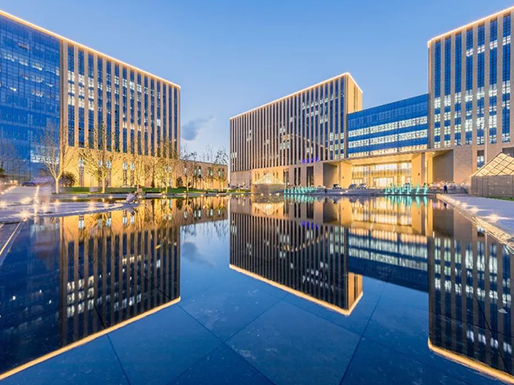
The School of Artificial Intelligence (Institute of Artificial Intelligence) at Beihang University was established in 2018 with the aim of leveraging the university's multidisciplinary strengths to lead fundamental theoretical research in AI, achieve breakthroughs in key technologies, and develop significant application system platforms, while cultivating outstanding and top-notch innovative talent. The school has developed a distinctive "1+M+N" development model, adhering to the philosophy of cultivating exceptional engineers through strong foundational knowledge, emphasis on practice, and integration of industry and education. It has formed a prominent hub for interdisciplinary education and research. The school comprises several research centers, including the Research Center of Applied Mathematics and Fundamentals of Intelligence, the Research Center of Perception Intelligence and Cognitive Intelligence, and the Research Center of Intelligent Detection and Collaborative Control Research Center. It has been approved as a National AI Industry-Education Integration Innovation Platform and hosts several provincial and ministerial-level research platforms, such as the Ministry of Education's Key Laboratory of Mathematics, Information, and Behavior, the Joint International Research Laboratory of Dark Matter and Refined Intelligence, the Ministry of Industry and Information Technology's Key Laboratory of "Integrated Precision Intelligent Sensing of Aerospace Optics-Microwave," and the Beijing Advanced Innovation Center for Future Blockchain and Privacy Computing. As the initiating unit, the school proposed and was among the first to receive approval from the Ministry of Education for an undergraduate program in artificial intelligence in 2018. It was also among the first in China to establish interdisciplinary degree authorization points in AI and was approved in 2023 as a first-tier doctoral discipline in artificial intelligence, pioneering a comprehensive bachelor-master-doctorate talent cultivation system in China. The AI program has been selected as a pilot program for integrated undergraduate-graduate education at the university. The discipline of artificial intelligence has been recognized as a Beijing High-Precision Discipline and approved for the National Special Program for Cultivating High-Level AI Talent in Critical Need. The school has assembled a faculty team that includes members of the Chinese Academy of Sciences.
1. The mathematics degree program, through the integration of mathematics and information science, systematically cultivates students’ holistic mindset and mode of thinking. It strengthens foundational theoretical innovation, highlights the ability to break front-line AI bottlenecks with mathematical methods, and constructs the main framework of next-generation AI mathematical theories and technical systems, thereby leading and underpinning the transformation of the AI discipline with mathematical and intelligent foundations.
2. Guided by the principles “solid foundations, strong interdisciplinarity, broad horizons, and innovation-driven”, the AI degree programs build an aerospace-featured cultivation system that fuses air, space and information domains, seamlessly integrating theoretical research with engineering technology.
- Master’s program: emphasizes forming an AI-related systems perspective and reinforces both theoretical research competence and hands-on engineering ability.
- Doctoral program: focuses on cultivating high-level builders and reliable successors of socialism who possess outstanding innovation, entrepreneurship and international competitiveness, and who will grow into visionary AI leaders.
3. Master of Engineering in Electronic Information: aims to produce application-oriented, versatile high-level engineering and management talents for national economic needs in all electronic-information-related fields.
Doctor of Engineering in Electronic Information: aligned with national mega-science projects (large aircraft, new-generation wireless systems, national PNT, manned space & lunar exploration, core chips, high-resolution earth observation, etc.), recruits frontline key contributors to these projects. It strives to breed interdisciplinary talents and highly responsible engineering leaders who have solid theory, creative thinking, foresight, organizational capacity and concerted breadth, while also understanding foreign cultures, mastering international rules, and commanding cross-cultural communication skills to track global industrial and technological trends.

| Name | Discipline | Research Focus | Profile Link | |
| 张宝昌 ZHANG Baochang | bczhang@buaa.edu.cn | Artificial Intelligence | Machine Learning, Computer Vision, Model Compression | https://github.com/bczhangbczhang ; https://iai.buaa.edu.cn/info/1013/1094.htm |
| 王田 WANG Tian | wangtian@buaa.edu.cn | Artificial Intelligence, Electronic Information | Pattern Recognition and Intelligent Systems, Video and Image Generation | https://iai.buaa.edu.cn/info/1013/1034.htm; https://shi.buaa.edu.cn/wangtian/zh_CN/index.htm |
| 厍睿 SHE Rui | ruishe@buaa.edu.cn | Artificial Intelligence, Electronic Information | Intelligent Perception, Intelligent Information Processing, Vehicle-Infrastructure Cooperation | https://iai.buaa.edu.cn/info/1013/3890.htm |
| 姜鑫 JIANG Xin | jiangxin@buaa.edu.cn | Mathematics, Electronic Information | Computer-Aided Manufacturing, Numerical Control Technology, Intelligent Manufacturing | https://iai.buaa.edu.cn/info/1013/1672.htm |
| 郭炳晖 GUO Binghui | guobinghui@buaa.edu.cn | Mathematics, Electronic Information | Fundamental Theories of Artificial Intelligence, Vertical Domain AI Models | https://shi.buaa.edu.cn/guobinghui/zh_CN/index.htm |
| 霍冠英 HUO Guanying | gyhuo@buaa.edu.cn | Mathematics, Electronic Information | Intelligent Manufacturing and Industrial Big Data Analysis | https://shi.buaa.edu.cn/hgy10452/zh_CN/more/36899/jsjjgd/ |
| 温思嘉 WEN Sijia | wen_sijia@buaa.edu.cn | Artificial Intelligence, Electronic Information | Intelligent Perception | wensijia.work |